Uncontrolled air exchange is the biggest contributor to heat losses today, and we must take a fresh look at the building fabric and the various ways in which energy is transferred – not only via heat conduction through materials, but also the effects of heat exchange via radiation and via convection through joints, gaps, cracks and penetrations.
Air Leakage Vs Ventilation
It is essential to differentiate between air leakage and ventilation. Nearly half of all heat lost from the average home is a result of uncontrolled air leakage through gaps in the structure. Air leakage happens where the building has not been properly sealed so air “escapes” from the building interior. This is distinctly different from natural ventilation through vents designed as part of the building structure – such as windows and ventilators – that can be controlled by occupants. However, both combating air leakage and providing effective ventilation require a suitably airtight building.
Reduces the effectiveness of the building envelope
Promotes warm air leakage from the building into the roof space
Increases air infiltration into the heated building
Introduces dirt, dust and insects into the roof construction
Introduces external moisture laden air into the construction
The best way to eliminate uncontrolled air leakage is to form a sealed building envelope that consists of an airtight internal layer such as DuPont™ AirGuard® air and vapour control layers (AVCLs) and a breathable but watertight external membrane like DuPont™ Tyvek® breathable membranes.
Non-Ventilated Roofs Are More Efficient
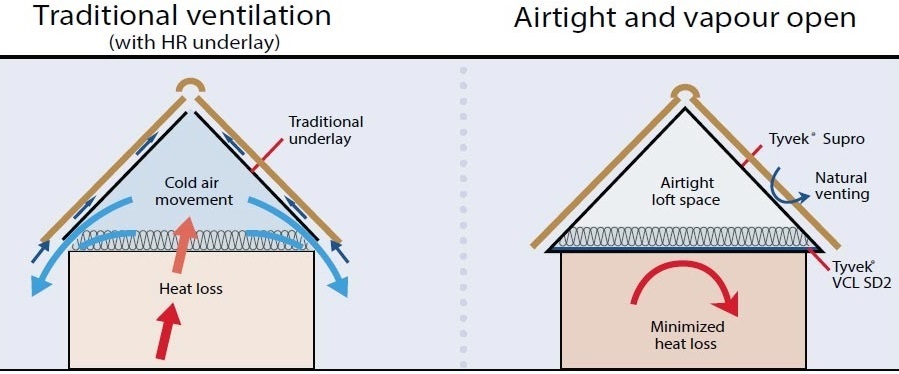
Tests by the BRE using real houses show a non-ventilated roof system is four times more efficient than a traditional ventilated system. An integrated vapour control/air barrier layer on the warm side of the insulation improves performance of the product. This is where DuPont™ Tyvek®breather membrane products and DuPont™ AirGuard® AVCL products come into their own.
The airtight and watertight qualities of DuPont™ Tyvek® membranes means they prevent interstitial condensation and improve energy efficiency therefore saving money and reducing CO2 emissions.
Tyvek® Supro and Tyvek® Supro Plus
Tyvek® Supro is a durable, water resistant membrane that is reinforced with a laminated polypropylene nonwoven. This airtight, vapour-permeable membrane is extremely water-resistant, and it is suitable for all supported and unsupported pitched roofs. It does not need any soffit, tile or ridge ventilation, which can save time as well as money in the construction process.
Tyvek® Supro Plus offers the same benefits, plus an integral adhesive lap tape designed for use in the Tyvek® sealed roof system. Sealing all horizontal laps contributes to the system’s thermal efficiency by reducing air infiltration.
 Building
Products
Building
Products